
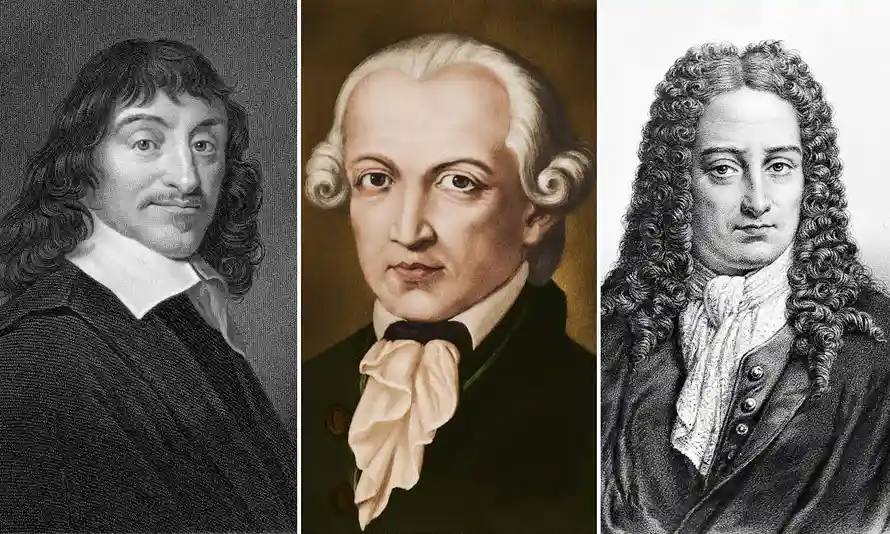
Rationalism, in Western philosophy, is the view that regards ‘reason’ as the chief source and test of knowledge.
Rationalist Philosophers
René Descartes (1596-1650) was a French philosopher who is often studied as the first great philosopher in the era of “modern philosophy.”
Benedict de Spinoza (1632-77), the Dutch Jewish philosopher introduced a conception of philosophizing that was new to the Renaissance (renewed interest in something); philosophy became a personal and moral quest for wisdom and the achievement of human perfection.
Gottfried Wilhelm Leibniz (1646 – 1716 CE) was a German philosopher and mathematician who invented calculus at the same time as Newton and we still use his system of notation.
| Substance | God | Theory- Rationalism | |
| Descartes | Descartes advocates “substance dualism,” which states that the mind and the body are two different substances. While the body is material (corporeal), the mind is immaterial (incorporeal). | Descartes proves the existence of God in his ontological (nature of being) argument by stating that God’s existence is an idea of a supremely perfect being without contradiction. Descartes stated that God’s existence is self-evident as the most basic mathematical truth. | Descartes was the first significant rationalist philosopher of the modern classical period. He rejects sense experience as a trustworthy source of knowledge early in his Meditations. |
| Spinoza | For Spinoza, there is only one substance which is ‘God or Nature’.(1) there is only one substance; (2) this substance has infinitely many attributes; (3) this substance is God or nature; (4) each of these attributes express the divine essence; and (5) all else is a mode or modifications of the one substance. | Spinoza understands a substance to be something that is self-caused and self-explained. Spinoza further believes that metaphysical rationalism entails that at least and at most one substance exists and that this substance necessarily exists and is absolutely infinite, and consequently that this substance is God (according to Spinoza’s definition, God is an absolutely infinite substance) and that all else inheres in this substance – that is, all else is explained by, caused by, and conceived through this substance. | Metaphysical rationalism claims that everything has a cause or reason.Spinozistic rationalism defines substances as self-caused, conceived through themselves, and self-explanatory. |
| Leibnitz | A substance is that subject which could have many predicates, but it is not a predicate of any other subject.For Leibnitz, monad is a simple substance which cannot be divided into parts. A compound substance may be formed by an aggregation of monads. | God, according to Leibniz, is (i) a necessary being, (ii) the explanation of the universe, and (iii) the infinite intelligence. | Leibniz, a Rationalist, believes that the world was rationally created by God, who controls all in the best and most rational of all possible worlds, and so he assumes that each thing can be rationally explained because each thing was rationally created.This is a teleological view (explanation of phemomenon in terms of purpose), what many call today intelligent design. |
For Video tutorial, click link below:


Drop your thoughts below!