
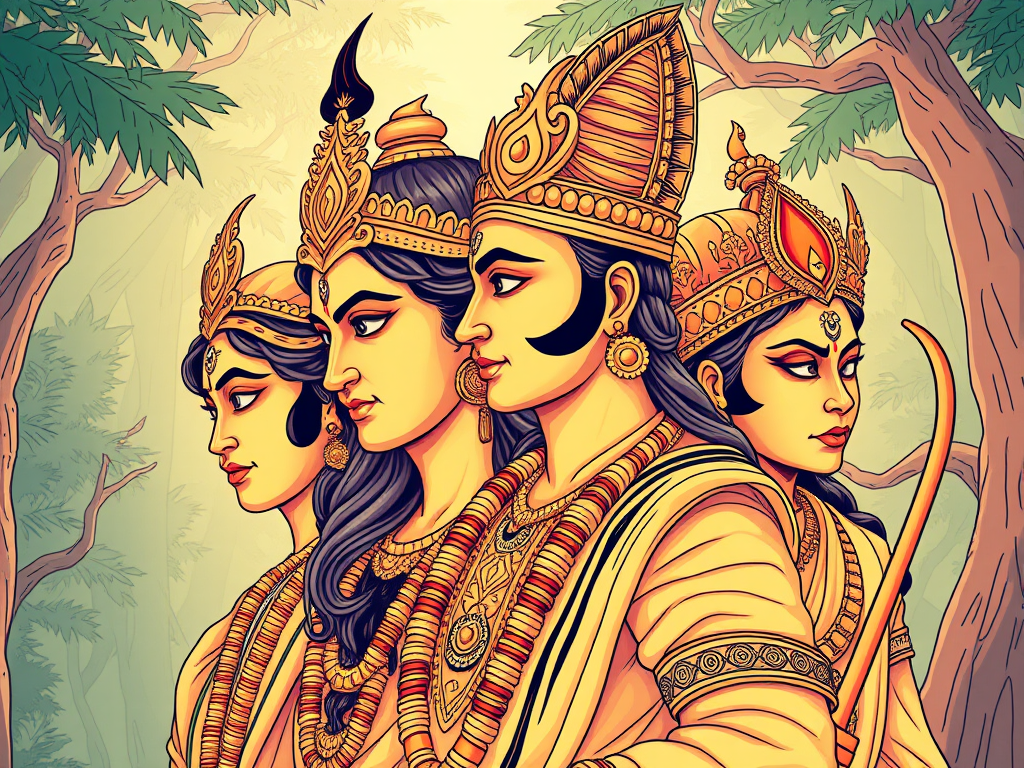
Ramayana is an interesting epic we learn about from childhood. It teaches important lessons about being an ideal person, emphasizing loyalty, brotherhood, and respect for elders. Children who study the Ramayana grow mentally, intellectually, and spiritually. If you want to quickly understand its introduction and storyline, you’re in the right place. This lesson will help you review the key elements of the Ramayana and appreciate its depth and beauty. So, keep reading this epic and share it with others to help them benefit from its teachings.
Introduction to Ramayana
- Oldest Epic:
- The Ramayana is the oldest epic in world literature.
- It has a special place in Indian culture and Sanskrit literature, influencing music, dance, art, and architecture.
- Historical Context:
- Written around 500 AD by Maharshi Valmiki, though told orally for centuries before that.
- Versions of Ramayana: “Valmiki Ramayana”-Maharishi Valmiki, “Adyathm Ramayana”-Maharishi Ved Vyas, “Shri Ramcharitmanas”-Goswami Tulsidas
- Believed to circulate among people as long as the mountains stand.
- Treatise of Dharma:
- Focuses on the four Purusharthas (values of life): Dharma, Artha, Kama, and Moksha.
- Emphasizes Dharma through the conduct of Rama and other characters.
- Shows that Dharma will triumph, but it may require personal sacrifice for societal benefit.
- Valmiki’s Influence:
- Valmiki is regarded as the first poet (Adikavi), and Ramayana as the first epic (Adikavya).
- Valmiki’s poetic style influenced later Sanskrit poets and classical literature.
- Popular Versions:
- Three Main Versions: Northwest, East, and Southern (Southern recension is used for the current translation).
- The Role of Commentaries:
- Ramayana has been interpreted by various scholars with different philosophical schools.
- Notable commentaries include Amrithakataka, Dhramakutam, Tattvadipika Tilaka, and Siromani.
- The commentary translations aim to help readers understand the philosophical concepts embedded in the Ramayana.
- Ramayana’s Oral Tradition:
- Despite being composed in classical Sanskrit, oral expounders made the Ramayana accessible to the masses, especially in rural India.
- Lava and Kusha were the first exponents, trained by Valmiki himself.
- Reciting Sundara Kanda daily is a common practice.
- Cultural Impact:
- Rama is revered as a heroic god-man, embodying the ideal man and Dharma.
- The story’s exploration of human relationships and values in royal households makes it relatable and influential.
- The Ramayana teaches that Artha (wealth) and Kama (desires) must be pursued within the boundaries of Dharma.
- Philosophical and Social Values:
- Illustrates a value system important to much of Indian education and philosophy.
- Teaches how to live a life of righteousness, duty, and family values.
- Enduring Devotion and Popularity:
- The Ramayana remains a source of devotion and moral guidance, fostering a deeper commitment to Dharma.
- It is central to Indian culture, inspiring individuals to live a life of virtue, integrity, and spiritual discipline.


Characters in Ramayana
- DASARATHA: King of Kosala, ruled from Ayodhya.
- SUMANTHRA: Dasaratha’s main advisor.
- VASISHTHA: The royal priest of Dasaratha.
- VISWAMITHRA: Teacher to Rama and Lakshmana; once a warrior, he became a respected teacher and saint.
- KOONI: Kaikeyi’s servant, whose troublemaking led to serious consequences.
- Janaka: King.
- SITA: His adopted daughter, also known as Janaki, the main female character in the Ramayana.
- SOORPANAKA: A demoness, sister of Ravana; Kara is the leader of her demon army.
- JATAYU: A great eagle who vowed to protect Dasaratha’s children; his brother, Sampathi, lost his shape after challenging the sun but regained it upon hearing Rama’s name.
- VALI: The king of Kiskinda, home to a race of giant monkeys.
- SUGREEVA: Vali’s brother, who helped ensure Vali’s death with Rama’s assistance.
- TARA: Vali’s wife.
- ANGADA: Vali’s son.
- HANUMAN: Sugreeva’s ally and Rama’s greatest devotee; son of the wind god, known for his strength and wisdom.
- JAMBAVAN: A wise elder in Hanuman’s team, now looks like a bear.
- THATAKA: A demoness, her father is Suketha, and her husband is Sunda. SUBAHU and MAREECHA: her sons.
- GAUTAMA: a sage who cursed his wife, AHALYA, for infidelity.
- BHAGIRATHA: brought the Ganges to earth to obtain salvation for his ancestors.
- MAHABALI: a conqueror; Vishnu incarnated as VAMANA to end his tyranny.
- MAHAVISHNU: the Supreme God, divided into Brahma, Vishnu, and Shiva for the universe’s functioning.
The Storyline of the Ramayana
The Ramayana – Epic consists of seven books (Kandas) and explores themes like duty, honor, loyalty, and the fight between good and evil.
1. Bala Kanda (First Book of the Ramayana)
- King Dasharatha’s Family:
- King Dasharatha of Ayodhya had three wives: Kausalya, Kaikeyi, and Sumitra.
- Despite this, he was childless.
- Putrakameshti Yagya:
- Dasharatha performs a Putrakameshti Yagya (fire sacrifice) to have children.
- The sacrifice blesses him with four children:
- Rama to Kausalya.
- Bharata to Kaikeyi.
- Lakshmana and Shatrughna to Sumitra.
- Childhood of Rama and Siblings:
- The children grow up learning scriptures, combat, and warfare.
- Rama and Lakshmana are depicted as valiant and virtuous even from a young age.
- Rama and the Demons:
- Vishwamitra, a sage, seeks Dasharatha’s help to protect his sacrificial rites from demons.
- Rama and Lakshmana defeat the demons, showing Rama’s courage at the age of 16.
- Rama and Sita’s Marriage:
- The origin of Sita: She was found in a field by King Janaka of Mithila.
- Sita is considered a divine gift.
- Rama wins Sita’s hand by lifting and stringing Shiva’s bow, a task that only he could accomplish.
- Marriages of the Brothers:
- Rama marries Sita.
- Lakshmana marries Urmila, Bharata marries Mandavi, and Shatrughna marries Shrutakirti.
- Devotion of Lakshmana:
- Lakshmana’s unwavering devotion to Rama is highlighted throughout, as he loyally follows Rama in all circumstances.
2. Ayodhya Kanda (Second Book of the Ramayana)
- Dasharatha’s Decision:
- After 12 years of Rama’s marriage, King Dasharatha decides to crown Rama as the next king of Ayodhya.
- The decision is supported by the Kosala assembly and the people.
- Manthara’s Scheme:
- Manthara, a maidservant, manipulates Kaikeyi, stirring jealousy and anger.
- Kaikeyi demands two wishes from Dasharatha, which were granted to her long ago:
- Rama’s exile for 14 years.
- Bharata to be crowned king instead of Rama.
- Dasharatha’s Dilemma:
- Dasharatha, bound by his promise, is forced to agree to Kaikeyi’s wishes.
- He is devastated by the situation.
- Rama’s Response:
- Rama accepts the exile calmly without protest, showing great self-control.
- He is joined by Sita and Lakshmana, despite his initial reluctance for Sita to accompany him.
- Bharata’s Refusal:
- Bharata, who was away, returns and is heartbroken upon learning of Kaikeyi’s manipulation.
- He refuses the throne and asks Rama to return.
- Rama’s Loyalty:
- Rama, a devoted son, refuses to return before the end of his 14-year exile, adhering to his father’s command.
- Bharata’s Symbolic Rule:
- Bharata places Rama’s sandals on the throne and rules as a representative of Rama, promising to give up royal comforts until Rama returns.
3. Aranya Kanda (The Book of the Forest)
- Destruction of Khara:
- Khara, the demon brother of Surpanakha, organizes an attack on Rama and Lakshmana.
- This is in retaliation for Lakshmana mutilating Surpanakha after she attempted to harm Sita.
- Rama defeats Khara and his demons.
- Capture of Sita by Ravana:
- Ravana kidnaps Sita after she crosses the Lakshmana Rekha, which was drawn for her protection.
- Ravana, disguised as a man, deceives Sita into leaving the safety of the Rekha.
- He forcibly abducts her to Lanka, seeking revenge for the insult to his sister Surpanakha.
- Sita’s refusal to marry Ravana:
- In Lanka, Ravana demands Sita to marry him.
- Sita, remaining loyal to Rama, refuses Ravana’s proposal.
- Rama and Lakshmana’s search for Sita:
- Rama and Lakshmana, informed of Sita’s abduction by Jatayu, begin their journey to rescue her.
- They meet the demon Kabandha and the devotee Shabari, who guide them to Hanuman and Sugriva.
4. Kishkindha Kanda (The Book of Kishkindha)
- Introduction to Kishkindha:
- The story is set in Kishkindha, the kingdom of the vanaras (monkey people).
- Rama and Lakshmana meet Hanuman, the greatest devotee of Lord Rama.
- Rama helps Sugriva:
- Rama helps Sugriva defeat his brother Vali, who had taken Sugriva’s kingdom.
- In return, Sugriva promises to help Rama find Sita.
- Sugriva forgets his promise:
- Sugriva neglects his promise to Rama, delaying the search for Sita.
- Tara, Vali’s wife, reminds Sugriva of his duty and convinces him to help Rama.
- Tara also stops Rama from destroying the citadel in anger.
- Search for Sita:
- Sugriva sends vanara search armies in all directions.
- Armies from the north, west, and east return empty-handed.
- The southern army, led by Angad and Hanuman, learns from the vulture Sampati that Sita is in Lanka.
5. Sundara Kanda (The Book of Beauty)
- Hanuman’s Adventures:
- The Sundara Kanda focuses on Hanuman’s incredible feats and physical strength.
- Hanuman grows to a massive size and leaps across the sea to Lanka.
- Challenges Along the Way:
- He faces and defeats many demons who test his abilities, but none stop him.
- Hanuman’s Rampage in Lanka:
- Upon reaching Lanka, Hanuman wreaks havoc, destroying trees, buildings, and killing Ravana’s warriors.
- Capture and Dialogue with Ravana:
- Hanuman is captured and brought before Ravana, pleading for Sita’s release.
- Ravana refuses and has Hanuman’s tail set on fire.
- Escape and Return:
- Hanuman escapes, leaps across roofs, and spreads fire throughout Ravana’s citadel.
- He returns to Kishkindha with the joyous news about Sita’s location.
6. Yuddha Kanda (The Book of War)
- The Great War:
- Yuddha Kanda describes the epic battle between Rama’s army and Ravana’s forces.
- Rama and his army build the Rama Setu bridge across the sea, using stones engraved with Rama’s name to float.
- Hanuman’s Feats:
- Hanuman carries Mount Sumeru to Lanka to find a cure for Lakshmana, who is injured by Indrajit’s weapon.
- Rama’s Victory:
- The war ends with Rama killing Ravana and crowning Vibhishana (Ravana’s brother) as the king of Lanka.
- Agni Pareeksha:
- Sita undergoes the Agni Pareeksha (fire test) to prove her purity, emerging unharmed with the blessing of Agni (Lord of Fire).
- Return to Ayodhya:
- Rama’s exile ends, and he returns to Ayodhya, where he is welcomed with lights and celebrations.
7. Uttara Kanda (The Book of the Aftermath)
- Rama’s Decision:
- Despite Sita passing the Agni Pareeksha, Rama yields to public opinion and banishes her to the forest.
- Sita’s Exile and Birth of Lava and Kusha:
- Sita, pregnant with twins, gives birth to Lava and Kusha in the forest, where they are raised by Sage Valmiki.
- The Ramayana Recital:
- Lava and Kusha recite the Ramayana in front of Rama, causing him deep grief when they speak of Sita.
- Sita’s Departure:
- Valmiki summons Sita, who then vanishes into the Earth, her true origin.
- Rama Learns of His Sons:
- Rama eventually learns that Lava and Kusha are his sons.
- Rama’s Return to Heaven:
- A divine messenger informs Rama that his earthly mission is complete, and he returns to his heavenly abode.
Themes of the Ramayana
- Dharma: The concept of duty and righteousness is central throughout the epic. Rama’s unwavering commitment to his duty as a son, husband, and king is one of the story’s defining themes.
- Good vs. Evil: The battle between Rama and Ravana symbolizes the eternal struggle between good (dharma) and evil (adharma). Rama is the epitome of virtue, while Ravana embodies arrogance, lust, and evil.
- Devotion: The characters, especially Hanuman, demonstrate deep devotion to their lord, Rama, highlighting the power of faith and loyalty.
- Sacrifice: Many characters in the Ramayana make personal sacrifices for the greater good, such as Rama’s exile and Sita’s willingness to undergo the trial by fire.
I hope you enjoyed this summary of the greatest epic! Please comment on how it helped you learn something new. Keep reading and growing!
Reference
Influence of Ramayana on Indian Art & Culture – Ramlila, Temples, Literary Works
The 7 Kandas of Ramayana, The Hindu Epic – Valmiki Ramayana
Introduction | Valmiki Ramayanam


Drop your thoughts below!